Common route families
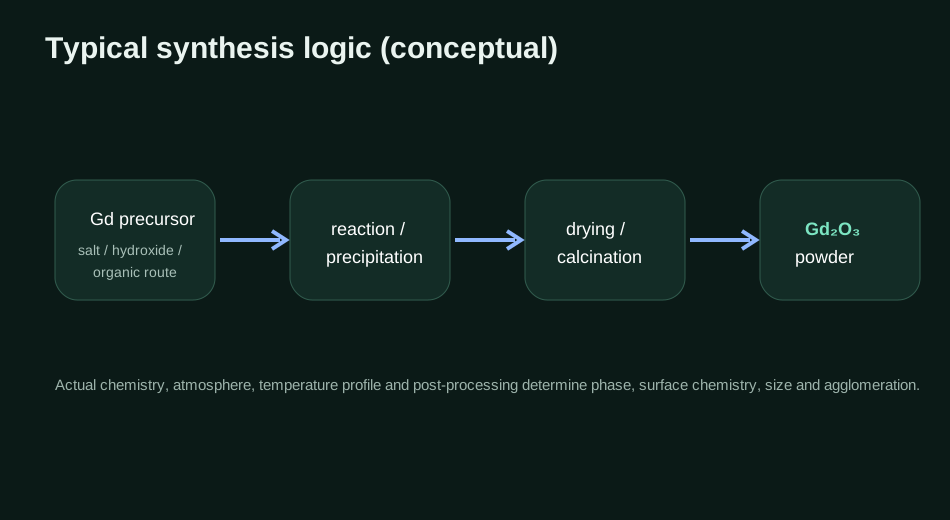
Literature reports precipitation/coprecipitation, sol-gel, combustion, hydrothermal/solvothermal and other routes for Gd₂O₃ and doped Gd₂O₃. Industrial powder production often includes precursor formation, separation/washing, drying, calcination and milling/classification.
Why calcination matters
Calcination converts precursors to the oxide and develops crystallinity, but higher thermal exposure can also increase grain growth and hard agglomeration. The “best” temperature is therefore not a universal number; it depends on precursor chemistry and final use.
Particle engineering levers
- Precursor concentration and supersaturation.
- pH and precipitation agent.
- Aging time and temperature.
- Washing efficiency and residual ions.
- Drying route.
- Calcination temperature/time/atmosphere.
- Milling, deagglomeration and classification.
- Surface modification for dispersion-sensitive systems.
For nanoparticle synthesis
Primary particle size, hydrodynamic size and agglomerate size are different quantities. Surface ligands or polymers may be introduced to control growth and colloidal stability. Biomedical research adds additional requirements such as sterility, endotoxin control, biological media stability and toxicology.
References
- PubChem. “Gadolinia / Gadolinium oxide (Gd₂O₃), CID 159427.” Molecular formula, molecular weight, identifiers and safety data. pubchem.ncbi.nlm.nih.gov.
- NIST Chemistry WebBook. “digadolinium trioxide.” Formula, molecular weight and CAS Registry Number. webbook.nist.gov.
- NIST Center for Neutron Research. “Neutron Scattering Lengths and Cross Sections.” Includes absorption cross sections for ¹⁵⁵Gd and ¹⁵⁷Gd. ncnr.nist.gov.
- U.S. Geological Survey. Mineral Commodity Summaries 2026 - Rare Earths. Supply and end-use context for rare-earth materials. usgs.gov.
- Thermo Fisher Scientific Chemicals. Gadolinium(III) oxide product specifications and SDS, CAS 12064-62-9. thermofisher.com.
- American Elements. Gadolinium oxide technical data including density and melting point. americanelements.com.
- Recent Progress in Gd-Containing Materials for Neutron Shielding Applications: A Review. Open-access review discussing Gd₂O₃ in glass, polymers, concrete and metals. PMC.
- Review on the synthesis, structural and photo-physical properties of Gd₂O₃ phosphors for various luminescent applications. Optik. ScienceDirect.
- Current Status and Future Aspects of Gadolinium Oxide Nanoparticles as Positive MRI Contrast Agents. Nanomaterials (2025). Research context and clinical-translation caveats. MDPI.
- Atomic Layer Deposition of Gd₂O₃ and Dy₂O₃. Chemistry of Materials. Thin-film structure and electrical-property research. ACS Publications.