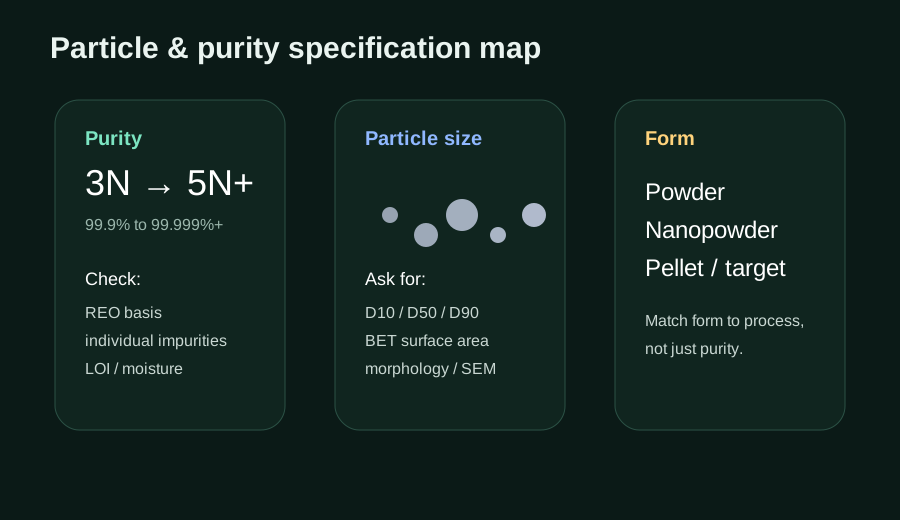
What 3N, 4N and 5N mean
| Shorthand | Nominal purity | Typical use of the term |
|---|---|---|
| 3N | 99.9% | General high-purity material work where trace impurities are less critical. |
| 4N | 99.99% | Higher-purity optical, electronic, research or synthesis applications. |
| 5N | 99.999% | Ultra-high-purity work where trace-element control is central. |
The shorthand does not tell you how purity was calculated. Rare-earth suppliers often report purity relative to total rare-earth oxides (REO), while non-rare-earth impurities, moisture or LOI may be treated separately. Always request the calculation basis.
Impurity profile beats headline purity
Two 4N powders can have different impurity distributions. If your application is sensitive to a specific contaminant, write a maximum for that element. Optical work may care about other rare-earth dopants and transition metals; electronics may care about alkali metals, carbon and halogens; ceramics may care about silica, calcium or iron depending on the formulation.
Particle-size metrics
- D10: 10% of the measured distribution is below this size.
- D50: median particle size.
- D90: 90% is below this size.
- BET surface area: useful for distinguishing high-surface-area powder from dense/agglomerated powder.
- SEM/TEM morphology: shows shape and agglomeration but should not be confused with bulk PSD.
Nanopowder is not just “smaller D50”
Nanopowders can be strongly agglomerated; a laser-diffraction D50 may describe agglomerates rather than primary crystallites. If nanoscale behavior matters, combine microscopy, crystallite-size analysis and surface-area data with dispersion-relevant measurements.
Suggested purchase specification
Incoming quality checks
- Confirm lot and COA match the purchase order.
- Retain a reference sample.
- Verify critical impurities with an appropriate method when risk justifies it.
- Track PSD and moisture if they affect processing.
- Record packaging integrity and storage conditions.
References
- PubChem. “Gadolinia / Gadolinium oxide (Gd₂O₃), CID 159427.” Molecular formula, molecular weight, identifiers and safety data. pubchem.ncbi.nlm.nih.gov.
- NIST Chemistry WebBook. “digadolinium trioxide.” Formula, molecular weight and CAS Registry Number. webbook.nist.gov.
- NIST Center for Neutron Research. “Neutron Scattering Lengths and Cross Sections.” Includes absorption cross sections for ¹⁵⁵Gd and ¹⁵⁷Gd. ncnr.nist.gov.
- U.S. Geological Survey. Mineral Commodity Summaries 2026 - Rare Earths. Supply and end-use context for rare-earth materials. usgs.gov.
- Thermo Fisher Scientific Chemicals. Gadolinium(III) oxide product specifications and SDS, CAS 12064-62-9. thermofisher.com.
- American Elements. Gadolinium oxide technical data including density and melting point. americanelements.com.
- Recent Progress in Gd-Containing Materials for Neutron Shielding Applications: A Review. Open-access review discussing Gd₂O₃ in glass, polymers, concrete and metals. PMC.
- Review on the synthesis, structural and photo-physical properties of Gd₂O₃ phosphors for various luminescent applications. Optik. ScienceDirect.
- Current Status and Future Aspects of Gadolinium Oxide Nanoparticles as Positive MRI Contrast Agents. Nanomaterials (2025). Research context and clinical-translation caveats. MDPI.
- Atomic Layer Deposition of Gd₂O₃ and Dy₂O₃. Chemistry of Materials. Thin-film structure and electrical-property research. ACS Publications.