Identity and naming
| Preferred technical name | Gadolinium(III) oxide |
|---|---|
| Common names | Gadolinium oxide; gadolinia; gadolinium sesquioxide; digadolinium trioxide |
| Formula | Gd₂O₃ |
| CAS Registry Number | 12064-62-9 |
| EC number | 235-060-9 |
| Molecular weight | 362.50 g/mol |
For purchasing and documentation, use the CAS number together with the formula. “Gadolinium oxide” can be used loosely in general writing; Gd₂O₃ removes ambiguity.
Physical properties
Commercial Gd₂O₃ is commonly described as a white solid or white powder. Representative supplier data list a density of about 7.407 g/cm³ and a melting point around 2,420 °C. These values are useful reference points but should not replace the specification attached to a specific grade or lot.
Crystal structure and polymorphs
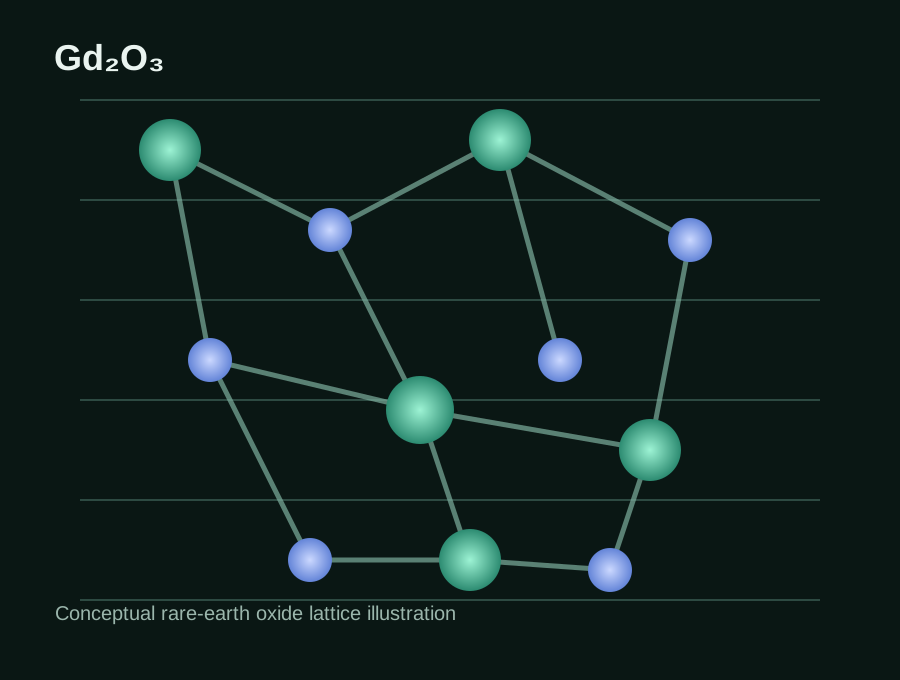
At ordinary conditions, gadolinium oxide is widely associated with the cubic rare-earth sesquioxide structure (often described as C-type, bixbyite-related). Literature also reports other polymorphs under different synthesis, temperature or pressure conditions. Powder processing can additionally introduce crystallite-size, strain and defect effects that are not captured by the chemical formula alone.
Chemical behavior
Gd₂O₃ is a stable rare-earth oxide and is widely used as a starting material for other gadolinium compounds. In practical processing, reactivity is influenced by particle size, surface area, calcination history and the acid/base system used. Nano- and high-surface-area grades should not be assumed to behave like coarse, strongly calcined powder.
What to measure when chemistry matters
- Loss on ignition (LOI) or moisture, especially for mass-balance work.
- Carbonate/hydroxide contamination if exposure and storage history are relevant.
- Trace anions such as chloride or sulfate if downstream chemistry is sensitive.
- Rare-earth impurity profile when optical or magnetic performance is sensitive to dopants.
Magnetic context
Gd³⁺ carries seven unpaired 4f electrons, which is why gadolinium-containing systems are important in magnetic and magnetic-resonance research. This does not mean bulk Gd₂O₃ powder is a drop-in medical MRI contrast agent. Biomedical nanoparticle work relies on carefully controlled size, surface chemistry, biodistribution and safety evaluation.
How to read property data responsibly
If two reputable sources disagree, first check whether they are describing the same phase, temperature, particle form and test method. For procurement, the hierarchy should normally be: purchase specification → current lot COA → product specification → SDS → general database or handbook value.
Primary sources and further reading
- PubChem. “Gadolinia / Gadolinium oxide (Gd₂O₃), CID 159427.” Molecular formula, molecular weight, identifiers and safety data. pubchem.ncbi.nlm.nih.gov.
- NIST Chemistry WebBook. “digadolinium trioxide.” Formula, molecular weight and CAS Registry Number. webbook.nist.gov.
- NIST Center for Neutron Research. “Neutron Scattering Lengths and Cross Sections.” Includes absorption cross sections for ¹⁵⁵Gd and ¹⁵⁷Gd. ncnr.nist.gov.
- U.S. Geological Survey. Mineral Commodity Summaries 2026 - Rare Earths. Supply and end-use context for rare-earth materials. usgs.gov.
- Thermo Fisher Scientific Chemicals. Gadolinium(III) oxide product specifications and SDS, CAS 12064-62-9. thermofisher.com.
- American Elements. Gadolinium oxide technical data including density and melting point. americanelements.com.
- Recent Progress in Gd-Containing Materials for Neutron Shielding Applications: A Review. Open-access review discussing Gd₂O₃ in glass, polymers, concrete and metals. PMC.
- Review on the synthesis, structural and photo-physical properties of Gd₂O₃ phosphors for various luminescent applications. Optik. ScienceDirect.
- Current Status and Future Aspects of Gadolinium Oxide Nanoparticles as Positive MRI Contrast Agents. Nanomaterials (2025). Research context and clinical-translation caveats. MDPI.
- Atomic Layer Deposition of Gd₂O₃ and Dy₂O₃. Chemistry of Materials. Thin-film structure and electrical-property research. ACS Publications.