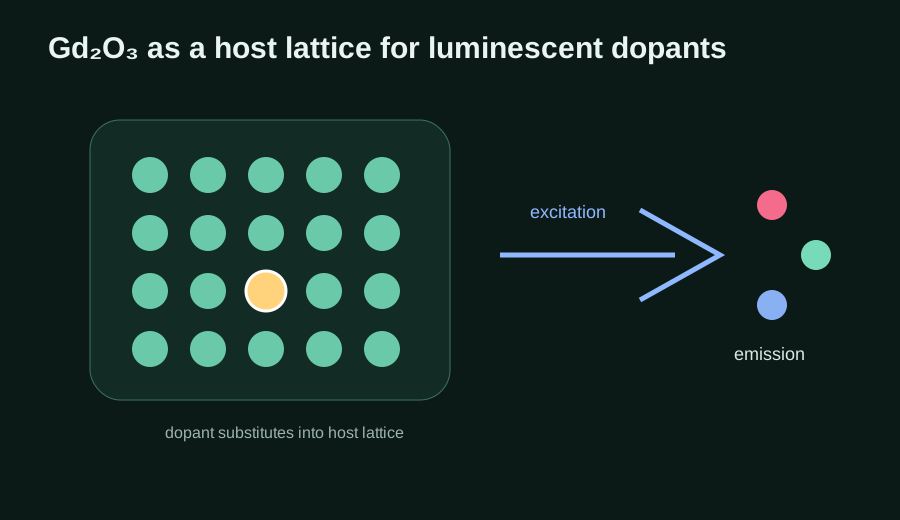
Why Gd₂O₃ works as a host lattice
Lanthanide oxides offer chemically and thermally stable frameworks in which optically active ions can be incorporated. Reviews of Gd₂O₃ phosphors discuss doping with multiple rare-earth ions and report narrow, characteristic emission features associated with the dopant ions.
What controls luminescence
- Dopant identity and concentration.
- Crystal phase and local coordination environment.
- Defects, vacancies and charge compensation.
- Crystallite size and particle morphology.
- Calcination temperature and atmosphere.
- Residual impurities, particularly other optically active rare earths and transition metals.
Procurement implication: “rare-earth purity” matters differently here
In an optical system, 99.99% total purity can still be insufficient if the remaining 0.01% contains an impurity with strong absorption or emission at a critical wavelength. Request an impurity table, not just a headline purity number. If spectral performance matters, set element-specific limits.
Optical glass and transparent materials
Gd₂O₃ is also investigated as a component of glass systems where density, refractive/optical behavior and radiation response can be modified. In neutron-shielding glasses, literature reports a useful combination of Gd loading and retained transparency in certain formulations. Actual transmission is formulation- and thickness-dependent.
Questions to ask a supplier
- Is purity reported on a total material basis or rare-earth-oxide (REO) basis?
- What are Eu, Tb, Dy, Sm, Fe and other spectrally relevant impurity limits?
- What is the D50 and agglomerate behavior?
- What calcination temperature/history is used?
- Can XRD and particle-size data be supplied for the lot?
References
- PubChem. “Gadolinia / Gadolinium oxide (Gd₂O₃), CID 159427.” Molecular formula, molecular weight, identifiers and safety data. pubchem.ncbi.nlm.nih.gov.
- NIST Chemistry WebBook. “digadolinium trioxide.” Formula, molecular weight and CAS Registry Number. webbook.nist.gov.
- NIST Center for Neutron Research. “Neutron Scattering Lengths and Cross Sections.” Includes absorption cross sections for ¹⁵⁵Gd and ¹⁵⁷Gd. ncnr.nist.gov.
- U.S. Geological Survey. Mineral Commodity Summaries 2026 - Rare Earths. Supply and end-use context for rare-earth materials. usgs.gov.
- Thermo Fisher Scientific Chemicals. Gadolinium(III) oxide product specifications and SDS, CAS 12064-62-9. thermofisher.com.
- American Elements. Gadolinium oxide technical data including density and melting point. americanelements.com.
- Recent Progress in Gd-Containing Materials for Neutron Shielding Applications: A Review. Open-access review discussing Gd₂O₃ in glass, polymers, concrete and metals. PMC.
- Review on the synthesis, structural and photo-physical properties of Gd₂O₃ phosphors for various luminescent applications. Optik. ScienceDirect.
- Current Status and Future Aspects of Gadolinium Oxide Nanoparticles as Positive MRI Contrast Agents. Nanomaterials (2025). Research context and clinical-translation caveats. MDPI.
- Atomic Layer Deposition of Gd₂O₃ and Dy₂O₃. Chemistry of Materials. Thin-film structure and electrical-property research. ACS Publications.